Gawain’s Test of Temptation
Sir Gawain and the Green KnightGawain’s Test of Temptation makes courtesy a trial with real stakes: Sir Gawain must answer Lady Bertilak’s advances without surrendering either his reputation for chivalry or his safety. The encounters move from playful talk and challenges to his conduct as a knight, then to the offer of a ring and a green lace said to protect its wearer. His acceptance of the lace, and agreement to conceal it from her lord, expose the limit of his ability to reconcile social courtesy with complete honesty.
Setting and Stakes
The test belongs to the sequence of Gawain’s travels away from King Arthur’s court. The poem introduces the adventure as a marvel concerning Arthur’s wonders; later, Gawain rides through a deep, wild forest among high hills. At the point when the temptation unfolds, he is a guest in the household of Bertilak. The scenes are therefore shaped by hospitality as well as by courtship: Lady Bertilak approaches him in the intimate setting of his bedchamber, while he remains a guest expected to behave according to the standards of a knight.
The danger of the larger journey sharpens the encounters. Gawain tells his host that he has only three days left before he must reach his destination and is as ready to die as to fail in his errand. Bertilak laughs and urges him to stay longer, assuring him that the Green Chapel will trouble him no more. The contrast is pointed: the journey’s openly acknowledged danger is a distant appointment, while the immediate test takes place through conversation, gesture, and the pressure to respond correctly. The reader sees a knight who has accepted an extraordinary adventure now navigating a more intimate trial of judgment.
Courtesy and Pressure
Lady Bertilak’s approach begins with a teasing reversal. She finds Gawain asleep, calls him an unwary sleeper, and says that he has been caught. Gawain welcomes her, and their exchange turns quickly to the terms of his release: he asks her to let him leave the bed and to persuade her husband to rise. The request is courteous and playful, but it also shows him trying to redirect an encounter in which she sets the pace.
Gawain answers her attention with modesty. When she treats him as the celebrated knight she expects, he denies that he is the man she describes and says he cannot claim the honor she gives him. That self-effacement is more than a mannerly flourish: it allows him to avoid accepting her praise as an invitation to intimacy while still acknowledging her status. His answer has to preserve both respect for his hostess and distance from her advances.
Lady Bertilak then makes the rules of the encounter explicit by invoking the conduct expected of a courteous knight. She argues that a kiss can be claimed quickly wherever an opportunity presents itself, and asks how someone so young, accomplished, and widely known for knighthood and courtesy could fail to understand the language of love. Her appeal binds romantic attention to the same public ideal Gawain is trying to uphold. A blunt refusal risks appearing discourteous; an eager response would cross the boundary he is trying to maintain.
The pressure becomes harder to evade as she presses close. The account describes a danger between them: Gawain must either accept her love or refuse it plainly. The predicament gives the exchange its force. His politeness is not simply a shield that ends the encounter; it leaves him answering within the very courtly code she uses to press him. The temptation thus tests how far graceful words can protect a knight when another person insists on treating courtesy as a sign of desire.
Gifts and Concealment
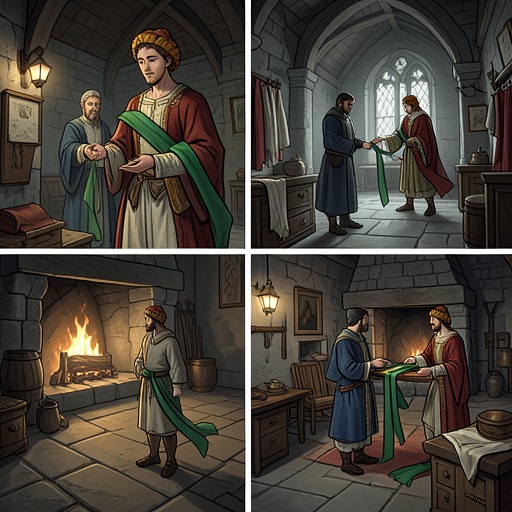
Lady Bertilak’s offers raise the stakes beyond verbal sparring. She first gives Gawain a richly worked red-gold ring topped with a shining stone, whose brilliance is compared to the bright sun. Its costly appearance makes the gift a visible token of favor. Gawain’s decisive acceptance, however, is of a different object: the green lace she presents with the claim that no man wearing it could be cut down while it remained close against him.
That promise speaks directly to his fear of failing his dangerous errand. Gawain accepts the lace willingly, and Lady Bertilak asks him, for her sake, never to disclose it but to keep it hidden from her lord. The request changes the meaning of his acceptance. The gift offers protection, but receiving it also creates a secret between Gawain and his hostess. His conduct has now moved beyond managing an awkward conversation: he has agreed to conceal something from the man whose household shelters him.
The green lace therefore gathers the test’s conflict into a concrete object. The ring displays wealth and favor; the lace promises survival and demands secrecy. Gawain’s earlier answers show him trying to meet each approach through restraint and courtesy, but the protective claim makes refusal costly in a more immediate sense. His acceptance reveals a vulnerability the language of chivalry alone cannot erase.
Revelation and Significance
The closing identification gives the temptation a larger frame. The speaker names himself Bertilak de Hautdesert and says that Morgan le Fay’s power was involved; she lives in his household. This disclosure connects the personal encounters at the castle with the adventure’s concealed design. The test has not been merely an isolated exercise in manners: the identity behind the hospitality, and the power associated with it, alter how the preceding pressures can be understood.
In its sequence of teasing, praise, challenge, gifts, and secrecy, Gawain’s Test of Temptation turns the conventions of courtly love into an examination of conduct. Lady Bertilak can frame a kiss as the due of a courteous knight, while Gawain tries to preserve courtesy without accepting her claim on him. When the green lace offers protection, the conflict shifts from appearance and reputation to the prospect of physical danger. The episode’s sharpest reversal is that the knight who has tried to answer every approach with controlled words ultimately accepts a gift whose value depends on concealment.